"A dangerous tree can fall without warning, damaging your home, injuring family members, or downing power lines. Oak City Tree Services provides free hazard tree assessments throughout Raleigh and Wake County NC. Oak City Tree Services and its ISA-certified crew identify the warning signs homeowners miss — before a tree becomes an emergency."
Across Raleigh, mature Willow Oaks, towering Loblolly Pines, and stately Red Oaks define neighborhood streets and backyards. These trees add shade, beauty, and property value, but like any living structure, they age, suffer disease, and can become unstable. The mistake most homeowners make is waiting for a dramatic sign — a storm, a loud crack, or a visible split — before asking for help. In practice, trees give off subtler signals for months or even years before failure. Knowing what to look for lets you address the problem while it is still safe, predictable, and cost-effective.
This in-depth guide explains the five most reliable indicators that a tree has become hazardous: dead or falling branches, trunk decay and cavities, a sudden or severe lean, root damage from construction, and disease or pest infestation that causes structural weakness. If you notice any single sign, schedule an assessment. If you see more than one at the same time, the risk is compounded and you should consider the situation urgent. Oak City Tree Services offers no-obligation evaluations throughout Raleigh and Wake County, and we will give you a straight answer: can the tree be saved, or is removal the safest choice?
1) Dead or Falling Branches (Widow Makers)
Dead branches are easy to underestimate because they look small compared to the whole tree. In reality, a single dead limb can weigh hundreds of pounds and fall on a calm day without wind. Arborists call these hanging hazards "widow makers" — partly broken branches that remain lodged high in the canopy. They can shake loose with minor vibration from a breeze, a squirrel, or a neighbor's lawn equipment. In busy areas like driveways, sidewalks, and play spaces, a falling branch is one of the most common causes of injury and property damage from trees.
Look for brittle, leafless branches, especially if they remain bare in spring while the rest of the tree leafs out. Peeling or sloughing bark, twigs that snap cleanly with a sharp crack, and clusters of dead wood concentrated in one section of the canopy are all red flags. In deciduous trees, compare both sides of the canopy — if one quadrant remains thin and fails to push new growth, it signals localized dieback that can progress to structural imbalance. In conifers like Loblolly Pine, browning needles and branch drop from the interior can indicate stress that will travel outward.
Another telltale sign is a branch stub where a limb broke during a previous storm but was never properly pruned. Stubs decay and invite fungal pathogens into the parent stem. Over time, the connection weakens and the remaining portion can shear off in a brittle fracture. Proper pruning cuts made just outside the branch collar reduce this risk; jagged tears and open stubs increase it. If you see a partly detached limb lodged in the crown, do not stand or park beneath it. Call a professional to safely rig and remove the widow maker before it drops.
2) Trunk Decay, Cavities, and Soft Wood
Trunk decay is deceptively dangerous because a tree can appear outwardly healthy while its interior wood fibers lose strength. Fungal organisms enter through wounds, pruning cuts, or root damage and slowly digest the lignin and cellulose that provide structure. The classic surface indicator is mushroom growth (fruiting bodies) at the base of the trunk or along seams. Conks — the shelf-like brackets that protrude from bark — are often associated with advanced decay. Their presence means the fungus has established a large internal network and is exporting nutrients to produce fruiting bodies.
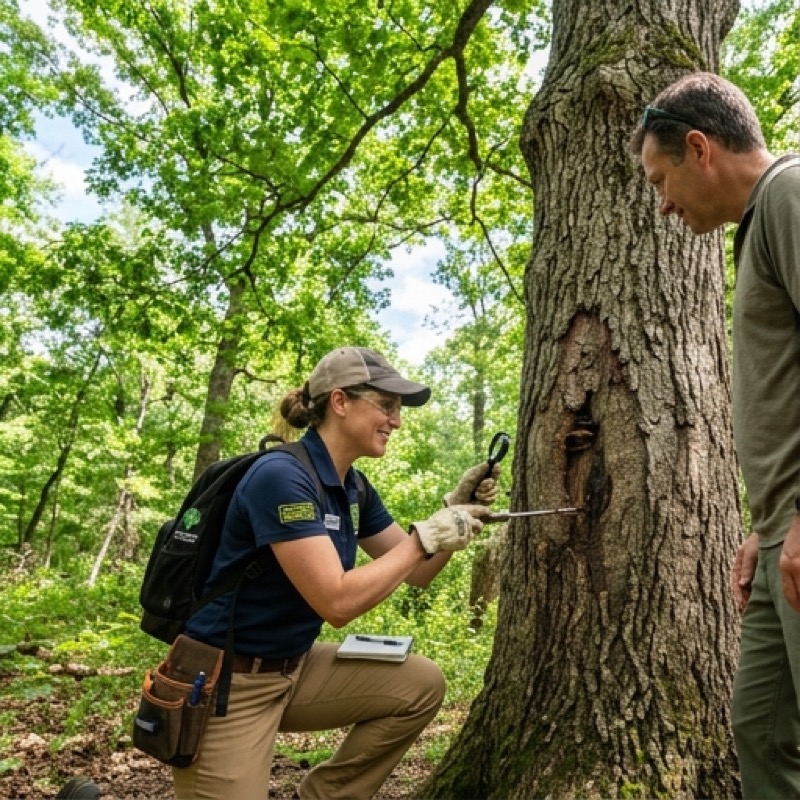
Inspect the trunk for cavities, seams, or areas of soft, spongy wood. A simple field check is the poke test: press a screwdriver or awl into suspect wood with light pressure. If it penetrates more than one to two inches, internal rot is likely present. Tap the trunk with a mallet and listen — a hollow, drum-like sound instead of a solid thud suggests voids. Also look for vertical cracks, spiral seams, or bulges that indicate uneven fiber strength. In species prone to compartmentalization failure, such as Water Oak, decay can progress rapidly and undermine the tree's ability to support canopy loads.
Remember that a hollow section does not automatically require removal, but the ratio of sound wood to decayed wood matters. As a rule of thumb, if more than one-third of the trunk's diameter is compromised, the risk of catastrophic failure increases significantly. Trees with cavities that open toward the prevailing wind, or trees that support large lateral limbs over targets (homes, streets, parking areas), warrant urgent evaluation. Our ISA-certified arborists use visual inspection combined with probing to determine whether reinforcement, pruning, or removal is the prudent course.
3) Severe or Sudden Lean
Not all leans are equal. Many trees develop a natural lean in response to light availability, and if that lean has been stable for years with balanced buttress roots, it may not be an immediate hazard. The danger arises when a tree shifts suddenly — after heavy rain, wind events, or ground disturbance — and the lean increases in a short period of time. A new lean indicates root plate movement or structural failure in the trunk or major roots.
Examine the soil around the base. Heaving or mounding on the side opposite the lean suggests the root plate is lifting and losing its grip. On the lean side, look for fresh cracks in the soil or separation between the soil and the root flare. These are signs of imminent failure. You may also notice bark cracks opening on the compression side of the trunk or hear intermittent creaking on windy days. If the tree is leaning toward a structure, driveway, play area, or power line, treat it as a high-priority risk. The combination of direction plus target determines urgency.
Documenting change helps. Take photos from the same vantage point a few days apart, or measure the distance from a fixed reference to the trunk at shoulder height. If the measurement changes, the lean is progressing. In saturated soils — common after Raleigh's heavy summer thunderstorms or during hurricane season — root systems of shallow-rooted species like Loblolly Pine are especially prone to pivoting. A tree that has shifted is unstable and unpredictable; bracing and guying are rarely effective at this stage. Call for a professional assessment immediately.
4) Root Damage and Construction Trauma
Roots anchor the tree and deliver water and nutrients. When they are severed, compacted, or suffocated, the damage may not show up in the canopy for months, but the structural weakness is immediate. Construction activity is the leading cause of root trauma we see across Raleigh and Wake County. Common culprits include utility trenching within the drip line, driveway or patio installation that raises grade over roots, and heavy equipment compacting soil during home renovations.
Because most tree roots live in the top 12–18 inches of soil, even shallow grading projects can remove or crush a large percentage of the absorbing roots. Cutting a single major structural root within two to three trunk diameters can significantly reduce stability. In neighborhoods experiencing rapid renovation and infill construction, we routinely evaluate trees that look outwardly fine but have compromised root systems due to past work. The risk persists for years.
Warning signs include dieback in the upper canopy, abnormal or early leaf drop, a thin crown with reduced annual shoot growth, and poor growth on the side where roots were cut. After heavy rain, you may notice standing water around the base where grade changes have trapped runoff, starving roots of oxygen. If your property recently underwent construction or landscaping and your tree's performance changed afterward, assume root trauma and schedule an inspection. In some cases, mulching, irrigation management, and selective pruning can reduce stress; in others, removal is the safest option.
5) Disease, Pest Infestation, and Dieback
Pathogens and insects weaken wood and disrupt vascular flow, creating structural imbalances that predispose trees to failure. Two notable threats in North Carolina are the Emerald Ash Borer (EAB) and oak wilt-type syndromes. EAB larvae carve S-shaped galleries beneath the bark of ash trees, severing the phloem and xylem that transport nutrients and water. You may see D-shaped exit holes on the bark where adults emerge, epicormic shoots (water sprouts) on the trunk, and rapid canopy thinning. Infested ashes can go from apparently healthy to dead within two to three seasons and become brittle as they desiccate.
Oak diseases present differently. Early symptoms include wilting and bronzing leaves, especially in the upper crown, followed by progressive dieback that marches down the canopy. Because decay organisms often follow, you can end up with a tree that has both dead sections and areas of vigorous growth. This uneven load distribution increases torque on remaining sound wood during wind events. Other red flags across species include unusual bark patterns, oozing sap (slime flux), fine sawdust-like frass from boring insects, and cankers that girdle stems.
While some diseases are treatable when caught early, advanced infestations combined with structural defects usually warrant removal. For example, a large oak with conks at the base, dead upper limbs, and fresh frass on the trunk presents multiple simultaneous risk factors. Our team evaluates the whole picture — species, site conditions, targets, and the owner's tolerance for risk — before recommending a plan. If a tree can be pruned and monitored safely, we will tell you; if the safest option is removal, we will explain why and how to do it with minimal impact to your property.
If you see more than one warning sign at the same time — for instance, a sudden lean combined with conks at the base and dead upper limbs — do not wait. The risk compounds nonlinearly.
When to Call a Professional
Not every declining tree needs to come down. The right move is to get an expert set of eyes on the specific defects and the site. ISA-certified arborists are trained to distinguish cosmetic issues from structural hazards, and to weigh the likelihood of failure against the severity of the consequence if failure occurs. At Oak City Tree Services, our free assessments are educational by design: we show you the defects, explain how they affect the tree's biomechanics, and outline options that balance safety, value, and your goals for the property.
As a general rule, if you see more than one warning sign at the same time — for instance, a sudden lean combined with conks at the base and dead upper limbs — do not wait. The risk compounds nonlinearly. Trees do not heal in the human sense; they compartmentalize. Once decay colonizes a section, it remains. Strategic pruning can reduce lever arms and wind sail, and cabling may be appropriate in limited cases, but these measures cannot restore lost structural wood. When targets are present, removal is often the responsible decision.
Emergency vs. Planned Removal
Emergency removal is reserved for active hazards: a tree that has shifted in recent days and is leaning toward your home; a partially detached branch hanging over a driveway or play area; a large split in the trunk with audible creaking; or a tree impacted by a storm that is now resting on a structure or utility line. In these cases, call us immediately. We maintain 24/7 readiness and can usually arrive within 1–2 hours anywhere in Raleigh. Our priority is to neutralize the hazard safely, secure the site, and prevent secondary damage.
Planned removal is appropriate when defects are serious but not yet emergent. For example, a declining pine with progressive dieback and root plate fungus located in the back yard away from structures may be scheduled within two to four weeks. Planned removals allow us to coordinate the most efficient approach — rigging, crane assistance if needed, and debris logistics — which can save you money compared to an after-hours emergency response. If you are unsure which category your situation falls into, call for a free assessment and we will advise honestly.
Real-World Raleigh Examples
We have removed widow-maker limbs over Five Points driveways that fell without a breath of wind. We have dismantled 80-foot pines in North Hills that developed a new five-degree lean after a week of saturated soils. We have taken down grand but fatally compromised Water Oaks in Oakwood with conks ringing the base and hollow trunks that sounded like drums. In each case, the warning signs were visible before the emergency — and addressing them earlier would have reduced risk and cost. Use this guide as a checklist after storms and each spring as trees leaf out.
If you prefer to preserve a tree whenever possible, we share that value. We will always recommend pruning, soil care, and monitoring when they can keep a tree safe. But when removal is the clear, responsible option, our crew performs precise sectional rigging to protect lawns, fences, and structures. We handle permits when applicable, coordinate with crane partners for tight backyards, and leave your site clean with optional stump grinding to complete grade. Our goal is peace of mind: a safe property and clear next steps.
Frequently Asked Questions
How do I know if a tree is about to fall?
Can a dead tree fall on a calm day?
How much does hazard tree removal cost in Raleigh?
Do I need a permit to remove a hazard tree?
Do you offer emergency hazard tree removal?
Related Services and Next Steps
Explore our full service pages for more detail on process, safety, and scheduling:
- Tree Removal in Raleigh, NC — how we plan, rig, and perform safe removals.
- Emergency Tree Service — what to do after storm damage and how we respond 24/7.
- About Oak City Tree Services — meet Oak City Tree Services and the crew.
24/7 emergency service by city: Cary · Durham · Apex · Raleigh
Tree removal by city: Cary · Durham · Apex · Raleigh
Related reading: Tree removal cost in Raleigh · When to trim trees in NC · Raleigh tree ordinance & permits · All guides
Get a Free Hazard Tree Assessment in Raleigh NC.
Concerned about a leaning pine, dead limbs, or mushrooms at the base? We'll inspect your tree, explain the risk, and give you clear options. No obligation.
919-675-9756